
COSHH Compliance in Practice: How Managers Can Check That Controls Are Working
COSHH Compliance in Practice: How Managers Can Check That Controls Are Working

Effective COSHH management is demonstrated by how hazardous substances are controlled during everyday work, not by the number of assessment forms an organisation holds. Employers must understand where harmful exposure could occur, prevent it where reasonably practicable and maintain effective controls where exposure cannot be avoided.
Start with the work, not the paperwork
A substance register can help an organisation understand which chemicals are present, but it is only one part of COSHH compliance. Managers must also consider hazardous substances produced by work activities.
Dust from cutting, sanding or drilling, fumes from welding, vapours from cleaning products and mists from spraying may all create exposure risks. Biological agents and other harmful materials may also fall within COSHH, depending on the activity.
The starting point should therefore be the task.
Managers need to know:
- What substance is being used or generated?
- How could it enter the body?
- Who could be exposed?
- How often and for how long does the work take place?
- Are the existing controls suitable and consistently followed?
This approach helps prevent assessments becoming generic documents that bear little resemblance to what happens in the workplace.
Preventing and controlling exposure
COSHH requires employers to prevent exposure where reasonably practicable. This means considering whether the substance can be removed from the activity, replaced with a less hazardous alternative or avoided by changing the process.
Where prevention is not reasonably practicable, exposure must be adequately controlled. The preferred controls are normally those that reduce risk at source and do not depend entirely on individual behaviour.
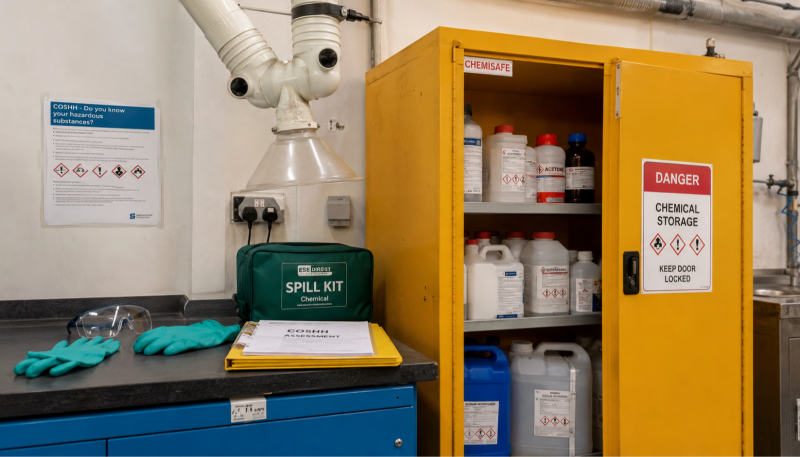
Depending on the work, these may include enclosed systems, local exhaust ventilation, segregation, restricted access, smaller quantities, safer application methods, controlled storage and planned cleaning arrangements.
Personal protective equipment may still form part of the control strategy, but it should not automatically be treated as the main solution. Its effectiveness depends on correct selection, fit, use, storage, maintenance and replacement. Managers should be able to explain why PPE is needed and what other controls have already been considered.
What management assurance should cover
Senior managers do not need to conduct every COSHH assessment themselves, but they should know whether the organisation has a reliable system for identifying and controlling exposure.
There should be clear responsibility for completing assessments, implementing actions, maintaining equipment and reviewing arrangements. Where an assessment identifies further work, it should name the person responsible and set a realistic completion date.
Managers should also test whether controls are working outside the assessment process. This may involve workplace inspections, discussions with employees, maintenance records, exposure monitoring or health surveillance where these are required.
Where local exhaust ventilation is used, it must be maintained in effective working order. HSE guidance states that most LEV systems should receive a thorough examination and test at least every 14 months. Reports should be reviewed rather than simply filed, and identified defects should be followed through to completion.
Common Compliance Weaknesses
One recurring weakness is using a safety data sheet as though it were a completed COSHH assessment. The sheet provides important information about a product, but it does not assess how much is used, how the task is performed, the workplace conditions or the people who may be exposed.
Other warning signs include:
- Assessments that use identical wording for very different tasks.
- No consideration of dust, fumes or other substances generated by work.
- Control measures that are listed but not available at the point of use.
- Contractors bringing substances onto site without suitable coordination.
- Poorly labelled or incorrectly stored containers.
- Assessments that have not been revisited after changes to equipment or working methods.
- LEV examination reports containing unresolved defects.
These gaps often indicate that COSHH is being managed as a document-control exercise rather than an operational risk.
Manager checklist
Use these checks to review your organisation’s arrangements:
- Does the COSHH inventory include substances produced by work activities?
- Can each assessment be linked to a recognisable task or process?
- Are inhalation, skin contact and accidental ingestion considered?
- Is there evidence that substitution or process changes were considered?
- Are contractors and maintenance activities included where relevant?
- Can the organisation demonstrate that engineering controls are maintained?
- Do workers understand the controls and emergency procedures?
- Are assessments reviewed following changes, incidents or evidence of ill health?
Information, instruction and competence
Anyone completing a COSHH assessment must have sufficient knowledge, skills and experience to understand the hazards, recognise likely exposure and select appropriate controls. A particular qualification is not always required, but the person must be competent for the work being assessed.
Employees need practical instruction that reflects their tasks. They should understand the health effects, required precautions, correct use of controls and PPE, and what to do following a spillage, equipment failure or unexpected exposure.
Maintenance staff, cleaners and contractors may require additional information because their work can involve non-routine exposure or interference with existing controls.
Frequently asked questions
- Must every hazardous product have a separate COSHH assessment?
The assessment should reflect the work and exposure risk. Similar products used in the same way may sometimes be considered together, but the assessment must remain suitable for each substance and task.
- Does an assessment have to be written down?
Employers with five or more employees must record the significant findings of the assessment and the steps taken to control risk.
- Are substances without hazard labels outside COSHH?
Not necessarily. Harmful dusts, fumes, vapours, mists, gases and biological agents may be covered even where they are generated by a process rather than supplied in labelled packaging.
- How often should assessments be reviewed?
There is no single review date suitable for every activity. Reviews should take place regularly and whenever there is reason to believe an assessment is no longer valid, including after changes, incidents, control failures or worker concerns.
Tags: article, coshh, compliance, occupational health, safety training, core health & safety
In Other News




Sign up to our newsletter
Most Read



Apprentice Dies After Engine Room Fire Suppression Activation
Fri 16th Oct 2026
Electrical Company Fined After Worker Crushed By Unsecured Load
Fri 16th Oct 2026

Life Changing Injury During Filming From A Moving Vehicle
Thu 15th Oct 2026

HSE Urges Early Action On Noise And Vibration Risks
Tue 13th Oct 2026
Landlord Sentenced For Failing To Arrange Annual Gas Safety Checks
Mon 12th Oct 2026


Worker Suffers Partial Thumb Loss During Manual Handling Task
Wed 7th Oct 2026